

What Is a Weighted University Grade?
A weighted university grade accounts for the fact that modules can carry different credit values. A 30-credit dissertation contributes three times as much to a credit-weighted average as a 10-credit module, provided both modules count under the same calculation rules.
A full-time academic year in England commonly represents 120 UK credits, but programme structures and classification rules can vary. Your transcript, module catalogue, or course handbook should show the credit value assigned to each module.
The Weighted Average Formula Explained Simply
Multiply each counted module mark by its credit value, add the results, then divide by the total counted credits. Higher-credit modules have a proportionally larger effect on this particular average.
Step-by-Step: How to Calculate It by Hand
You only need the marks and credit values shown on your transcript or student portal:
- List every counted module with its mark and credit value.
- Multiply each module mark by its credits.
- Add all the multiplied results.
- Add the credits for the modules entered.
- Divide the result from step three by the total credits.
The result is your credit-weighted average for the modules entered. Do not treat it as an official degree classification until you check which years and modules count under your programme regulations.
Worked Example With Real Numbers
Suppose you completed three modules:
| Module | Mark | Credits | Mark × credits |
|---|---|---|---|
| Module A | 66% | 20 | 1,320 |
| Module B | 55% | 10 | 550 |
| Module C | 71% | 10 | 710 |
| Total | 40 | 2,580 |
The simple average is 64%, but the credit-weighted result is 64.5%. The difference can become larger when modules have very different credit values.
Weighted vs Unweighted Average
An unweighted average treats every module equally: add the marks and divide by the number of modules. A credit-weighted average gives larger-credit modules more influence. Many UK universities use credit weighting within classification calculations, but they may differ on which modules and years count.
Why Higher-Credit Modules Count More
Credits primarily represent the volume of learning and expected workload attached to a module. In a credit-weighted calculation, a 30-credit module contributes three times as much as a 10-credit module. That does not make it more important in every academic sense; it gives it greater mathematical weight in this average.
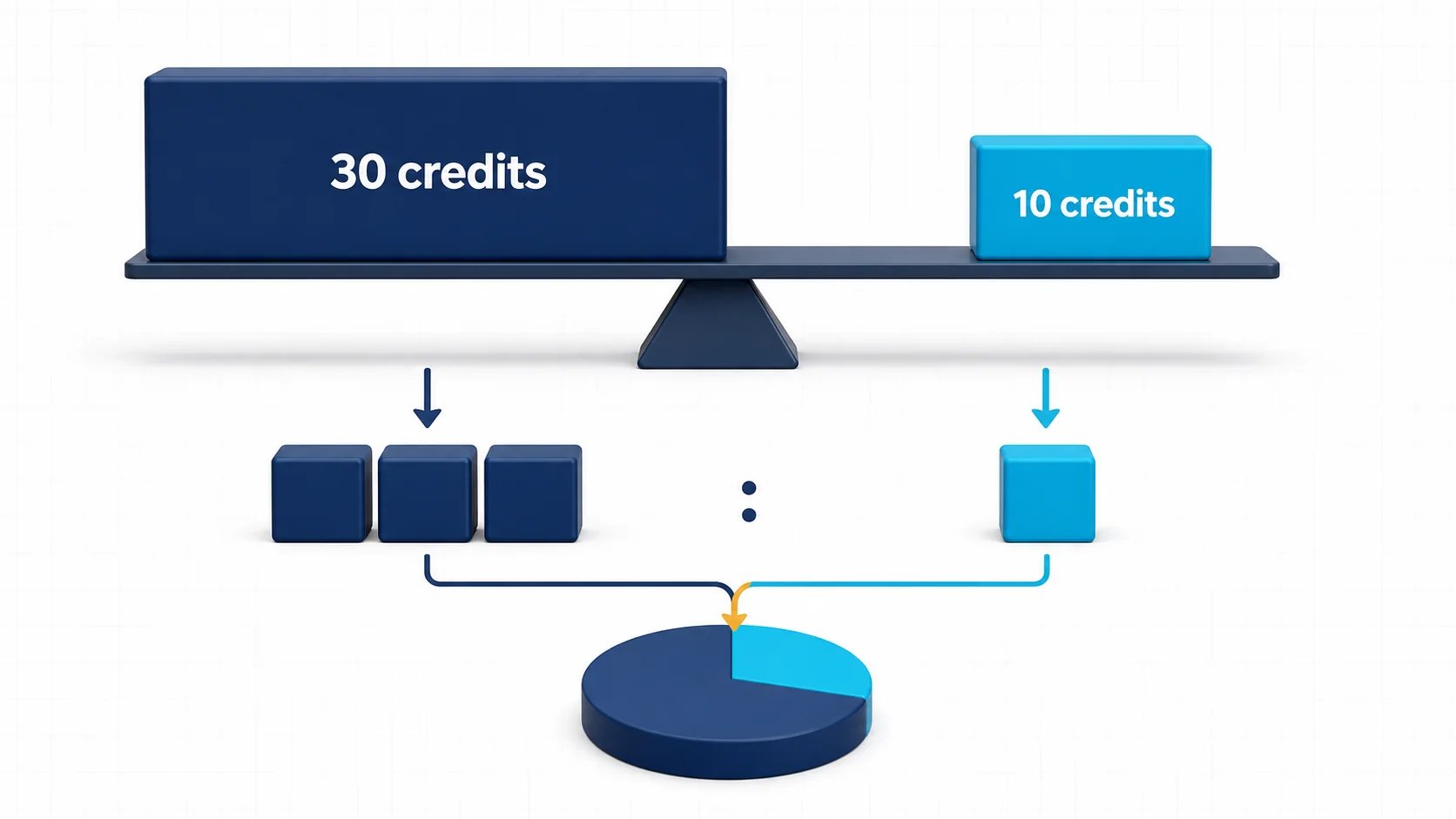
Example: A Dissertation vs a 10-Credit Module
Score 80% on a 30-credit dissertation and 50% on a 10-credit module:
The unweighted average would be 65%. The larger-credit dissertation has more influence in the credit-weighted result.
How Year Weighting Works at University
Universities do not all use the same year-weighting formula. Some exclude the first year, while others count it at a lower weight. Later years are often weighted more heavily, but the exact split depends on the institution, programme, start date, and regulations.
For example, the University of Leeds describes a 1:2 weighting between Years 2 and 3 for relevant bachelor’s degrees, while UCL publishes several classification schemes with different year and credit rules. These are examples, not universal UK formulas.
Common Calculation Mistakes
- Forgetting module credits and accidentally producing a simple average.
- Mixing assessment percentage weights with module credits.
- Assuming every module or academic year counts.
- Entering a credit total that does not match the transcript.
- Ignoring resit caps, rounding, compensation, or borderline rules.
Calculate Your Weighted University Grade
Doing the arithmetic by hand helps you understand the method, but long module lists make slips easy. Use our calculator to combine module marks with their credit values.
Use the separate Weighted Grade Calculator when combining assessments by percentage weight inside one module.
Frequently Asked Questions
What credits do I need for a 2:1?
There is no special number of credits that guarantees a 2:1. A 2:1 commonly begins around a 60% classification average, but the credits counted, boundary rules, and exact calculation depend on your university and programme.
Do all modules count towards final grade?
Not always. A university may exclude particular years, count only specified levels, use the best credits, or apply programme-specific exceptions. Check your course handbook.
Is weighted average the same as GPA?
No. A UK credit-weighted average is normally expressed as a percentage, while GPA uses grade points and credit hours. There is no universal UK-percentage-to-US-GPA conversion.
Why do higher-credit modules count more?
Each module mark is multiplied by its credit value, so a higher-credit module contributes proportionally more because it represents a larger volume of learning.